[ Credit Risk ]
Circulation Is Not Generation: Reading Related-Party and Circular Flows
Money moved between a promoter, a group entity and an operating account is not revenue. Related party transactions detection for lenders: identifying the parties, separating genuine trade from circulation, and why net flow is the only figure that counts.
9 min read · 17 September 2026
Contents
- Six kinds of related-party flow
- Net flow is the only figure that means anything
- Direction is the diagnosis
- How related parties are actually identified
- Genuine inter-company trade versus round-tripping
- What failing to net actually does to your numbers
- Read it monthly
- This is analysis, not accusation
- Frequently asked questions
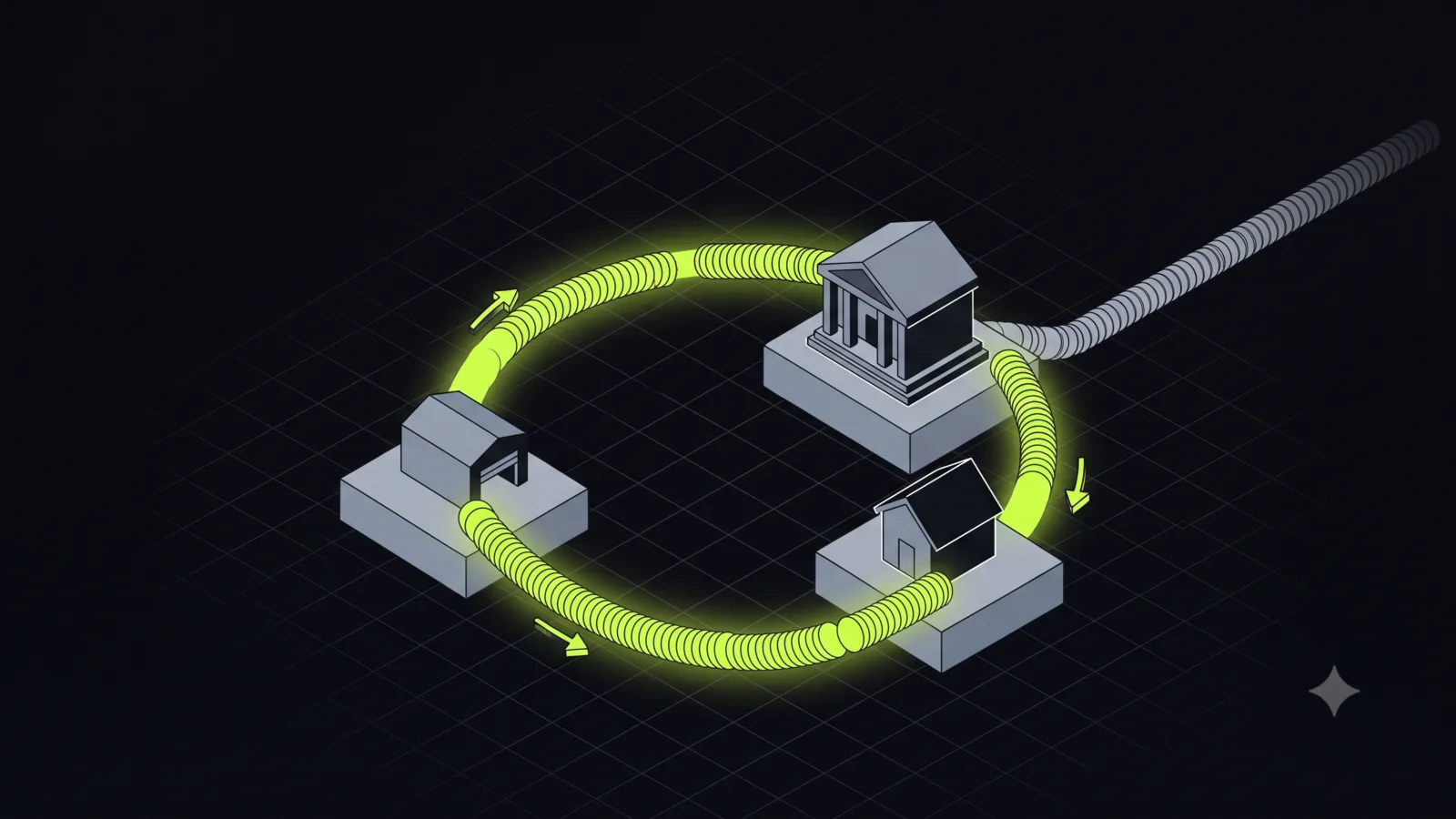
A business can manufacture turnover from nothing.
Move ₹1 crore from the operating account to a group entity, back to the promoter, and back to the operating account. Repeat ten times across a quarter. The account now shows ₹10 crore of credits. The business generated nothing. No goods moved, no service was rendered, no customer paid anything.
This is the central analytical problem in owner-managed lending, and it is not exotic. Nor is it marginal in scale. The Reserve Bank of India's Annual Report for 2025-26 put frauds in the advances category at ₹40,774 crore across 8,640 cases, close to 85% of all reported bank fraud by both number and value, though that amount includes ₹30,199 crore of older cases reclassified during the year. The overwhelming majority of related-party movement is nothing of the kind, which is precisely why the two have to be told apart rather than treated alike. The promoter, the family and the group are economically one unit and legally several, so money moves between them constantly — often for entirely legitimate reasons. Separating movement from generation is most of what distinguishes a credit view of a business from a transaction log.
Six kinds of related-party flow
They are not equivalent, and collapsing them into one bucket loses most of the information.
Self-transfers. The borrower moving money between their own accounts. Economically null in both directions. Any figure that counts these as turnover is wrong by exactly the amount moved.
Promoter infusion. Money entering the business from the promoter personally. This is capital support, and the reading is genuinely two-sided — it demonstrates commitment, and it demonstrates that operations are not covering themselves.
Promoter withdrawal. Drawings. The relevant question is scale relative to surplus: a business generating ₹8 lakh of monthly surplus while the promoter extracts ₹7 lakh has far less servicing capacity than the surplus alone suggests.
Inter-company trade. Transactions with group entities that may represent genuine commercial activity — or may not. This is the category requiring the most judgment, and the tests are set out below.
Circular round-tripping. Money leaving and returning, often through one or two intermediaries, with no commercial substance. The clearest indicator of manufactured turnover. The phrase carries a different meaning under FEMA, where round tripping describes Indian funds routed overseas and brought back as foreign investment. The sense used throughout this post is purely domestic.
Family flows. Household support in either direction. Frequently genuine, frequently indistinguishable from drawings without context.
Net flow is the only figure that means anything
Gross related-party activity tells you the volume of movement. Net tells you the direction of economic dependence, and only the second is a credit input.
Consider an account showing this over a period:
| Category | Credit | Debit | Net |
|---|---|---|---|
| Self transfers | ₹87,65,158 | (₹3,31,25,700) | (₹2,43,60,542) |
| Group / related | ₹0 | ₹0 | ₹0 |
| Total | (₹2,43,60,542) |
Gross movement here is over ₹4 crore. Counted as turnover it would transform the borrower's apparent scale. Netted, the finding is entirely different and considerably more interesting: ₹2.43 crore has left this account for related destinations and not returned.
That is a question, not a verdict, and the first thing it asks is where the money went. If the counterpart accounts are inside the case set, consolidation absorbs the movement and there is nothing further to explain. If they are not — and on a figure this size that is the more common finding — the money has crossed the boundary of what you can see.
Money leaving an operating account toward related destinations on this scale is either funding another group entity, quite possibly the one in difficulty, or being extracted. Either way it is capital that is not available to service your facility, and it is invisible in any analysis that reports gross credits.
Direction is the diagnosis
Once netted, the sign tells you what you are looking at.
Net inflow from related parties means the business is being supported rather than supporting itself. The size relative to operating receipts is the measure of dependence. A business covering 15% of its outflows from promoter funds is in a different condition from one covering 60%.
Net outflow to related parties means cash is leaving the entity you are lending to. This is the case most often missed, because an account with money flowing out looks healthy in every aggregate measure — throughput is high, balances may be fine, nothing bounces. The capital is simply going somewhere you cannot see.
Direction changing over time is the strongest signal of all. A business that was a net funder of its group and becomes a net recipient has had something change materially. That inversion typically precedes visible distress by months, which is why related-party net flow belongs in monitoring as much as in origination — it sits among the mid-sequence early warning indicators, well before conduct deteriorates.
The regulatory reading of a sustained net outflow is worth knowing, because it is less forgiving than the analytical one. The Reserve Bank of India's 2025 directions on the treatment of wilful and large defaulters, which replaced the previous set in November 2025, define diversion of funds to include transferring funds availed on a credit facility to subsidiaries or group companies, by whatever modality, without the approval of the bank or of all lenders in the consortium. Siphoning is defined more plainly still, as borrowed funds used for purposes unrelated to the operations of the borrower. Neither is a finding any analyst makes from a bank statement alone. Both are reasons to ask the question properly rather than leave it unasked.
How related parties are actually identified
Related party transactions detection rests on five methods, in rough order of reliability.
1. Account ownership matching. The borrower's own accounts are known from the case file. Transfers between them are self-transfers by definition, and both legs should be matched and eliminated rather than counted once on each side.
2. Name resolution on the counterparty. Requires the counterparty to be explicitly identified on every transaction rather than inferred. A transaction categorised as "transfer" with the narration echoed back cannot be tested against anything — which is why counterparty resolution is a prerequisite for this entire analysis, and why it varies so much between tools.
Some legs are structurally unresolvable whatever the tool does. Cash deposits, cheque clearing entries and same bank internal transfers frequently carry no counterparty identifier at all, and NEFT, RTGS, IMPS and UPI narrations carry them at very uneven quality. An honest system marks those for review rather than inventing a name for them.
3. Public-record enrichment. Company filings, directorships, shareholding and registered addresses establish relationships that names alone do not reveal. A promoter's spouse's proprietorship, or a group entity with no name similarity whatsoever, is invisible to string matching and obvious in a directorship search.
4. The both-sides test. The same counterparty appearing on both the debit and credit side of an account. This is the single strongest behavioural indicator, and it is available without any external data. Genuine trade relationships are usually directional — you sell to a customer and they pay you. A party that both sends and receives significant sums is either a genuine two-way trading relationship, which is uncommon and explicable, or a conduit.
5. Reversal timing. Money that leaves and returns within a short window, particularly in similar amounts. Round-tripping has a rhythm.
Genuine inter-company trade versus round-tripping
Group entities do trade with each other legitimately. The tests that separate real trade from circulation:
| Characteristic | Genuine trade | Circular flow |
|---|---|---|
| Amounts | Invoice-shaped — odd figures carrying GST and deductions | Round: ₹5,00,000, ₹10,00,000 |
| Direction | Predominantly one-way | Both directions, roughly balanced |
| Timing | Consistent with stated credit terms | Regular dates, or rapid reversal |
| GST trail | Appears in GSTR filings as outward supply | Absent from GST returns |
| Commercial rationale | Explicable — the entities are in the same supply chain | None offered, or vague |
The GST test is the most decisive of these, with one qualification that matters. If a group flow is described as a sale, it should have a matching outward supply in the GST return. Its absence does not prove circulation, but it removes the explanation that was offered, and the transaction then exists in the bank statement and nowhere else. That gap is what surfaces in the comparison between declared turnover and banked credits.
The qualification is that many entirely genuine related-party flows are not supplies at all and never appear in a GST return by design: inter-corporate loans and their repayment, capital infusion, security deposits, expense reimbursements, dividends, and transfers between branches under one GSTIN. The test separates trade from non-trade. It does not separate honest from dishonest, and treating it as though it does will produce confident false positives.
What failing to net actually does to your numbers
Four consequences, each of which moves the assessment in the borrower's favour.
Turnover inflates by the full volume of circulated money — potentially by multiples on a business that recycles aggressively.
DSCR improves incorrectly, because the numerator has grown while the obligations are unchanged.
Counterparty concentration understates risk. If a related entity is the largest contributor to receipts, the borrower does not have a dominant customer. They have themselves. A concentration analysis that ranks a group entity alongside genuine buyers reports diversification that does not exist.
Growth trends fabricate. Circulation can be increased at will. A business showing 40% year-on-year turnover growth driven by rising internal movement is not growing.
Each of these depends on the underlying categorisation identifying the flows in the first place. In our 200,001-transaction benchmark, transactions returned as a generic transfer with the narration repeated back — rather than with the counterparty resolved — formed a substantial share of the disagreement set. A related-party flow that was never attributed to an identifiable party cannot be netted, and the analysis silently proceeds on inflated figures.
Read it monthly
A period total conceals the pattern. The same net figure can describe a single large transfer or a steady monthly drain, and those are different businesses.
| Month | Self — debit | Self — credit | Net |
|---|---|---|---|
| Jul | (₹81,05,000) | ₹15,20,000 | (₹65,85,000) |
| Aug | (₹60,10,000) | ₹32,49,000 | (₹27,61,000) |
| Sep | (₹1,52,00,000) | ₹1,27,17,000 | (₹24,83,000) |
Gross movement in September is close to three times July's, while net outflow has fallen by more than half. Both facts matter and neither survives aggregation. Rising gross with falling net is the signature of increasing circulation — more money moving, less of it actually leaving — which is what manufactured turnover looks like in a monthly series.
This is analysis, not accusation
Related-party transactions are legal, normal and frequently sensible. Group treasury management, inter-company supply, promoter capital support and family funding are all ordinary features of Indian owner-managed businesses, and most of what this analysis surfaces has an innocent explanation.
The purpose is not to establish wrongdoing. It is to ensure that when you compute revenue, DSCR, concentration and growth, you are computing them on money the business actually generated. A borrower with ₹2 crore of legitimate inter-company trade is not a fraud risk. They are a borrower whose real scale is smaller than their gross credits suggest, and who deserves to be assessed at their real scale rather than declined for an inflated one they never claimed.
The same care applies as with any behavioural indicator: flag with evidence attached, route to a person, and ask rather than conclude.
Frequently asked questions
What are related-party transactions in bank statement analysis? Transactions between the borrower and parties connected to them — their own other accounts, the promoter personally, family members, or group companies under common ownership. They move money without necessarily representing economic activity, so they must be identified and netted before turnover or capacity is computed.
How do you detect circular transactions in a bank account? The strongest behavioural indicator is the same counterparty appearing on both the debit and credit side. Supporting signals include round-figure amounts, rapid reversal of similar sums, regular-date transfers, and an absence of any corresponding entry in GST filings.
Why does counting self-transfers inflate turnover? A transfer between a borrower's own accounts creates a debit in one and a credit in the other. Analysed separately and added, the same money is counted twice while representing no economic activity, and the inflation scales with how actively the borrower moves funds between accounts.
Is promoter funding a good or bad signal? Both, and the balance depends on scale and trend. It demonstrates commitment, and it demonstrates that operations are not self-sustaining. A business covering a small share of outflows from promoter funds differs materially from one covering most of them, and a rising trend is a deterioration signal regardless of the starting level.
How do you tell genuine inter-company trade from round-tripping? Genuine trade carries GST and appears in returns, involves invoice-shaped rather than round amounts, runs predominantly in one direction, and has an explicable commercial rationale. Circulation is round-figure, bidirectional, often rapidly reversed, and absent from GST filings.
Fiscus isolates self, group and related-party flows using public-record enrichment and counterparty resolution, reporting net flow month on month at both summary and transaction level. Book a parallel evaluation on owner-managed cases your team has already assessed.
Written by
Zeus DhanbhooraZeus Dhanbhoora is the CEO of BridgeUp Tech, the company behind Fiscus. He previously co-founded Bacferim Technologies and was an associate at the law firm Bharucha & Partners. He writes the Fiscus credit desk blog on benchmarks, fraud detection and credit underwriting methods.