[ Credit Analysis ]
One Model, Three Borrowers: Why Retail Statement Logic Fails on Business Accounts
Bank statement analysis for business loans is not retail logic at a larger scale. Where that logic breaks on self employed and SME accounts, why a failed payment and a returned deposit mean opposite things, and what normal looks like per segment.
10 min read · 17 September 2026

Contents
- Income: verification versus derivation
- The entity boundary does not exist for a sole proprietor
- Two cheque returns that mean opposite things
- Normal is segment-specific, so fraud rules must be too
- Counterparties: peripheral for retail, central for business
- Multi-account is the default, not the exception
- Micro and MFI borrowers are a third case, not a smaller second one
- What this means when selecting a tool
- Frequently asked questions
Most bank statement analysis was built for the salaried borrower first, because that is where volume and standardisation are. Bank statement analysis for business loans was then accommodated by stretching the same logic: more categories, a few extra ratios, the same underlying assumptions.
The assumptions do not stretch. A salaried account and an owner-managed business account are not the same object at different scales. They differ in what income looks like, where the boundary of the entity sits, what constitutes normal behaviour, and what a failed payment means. A model that treats them as variations of one another does not merely lose precision on the business segment. It produces specific, predictable, confident errors.
Income: verification versus derivation
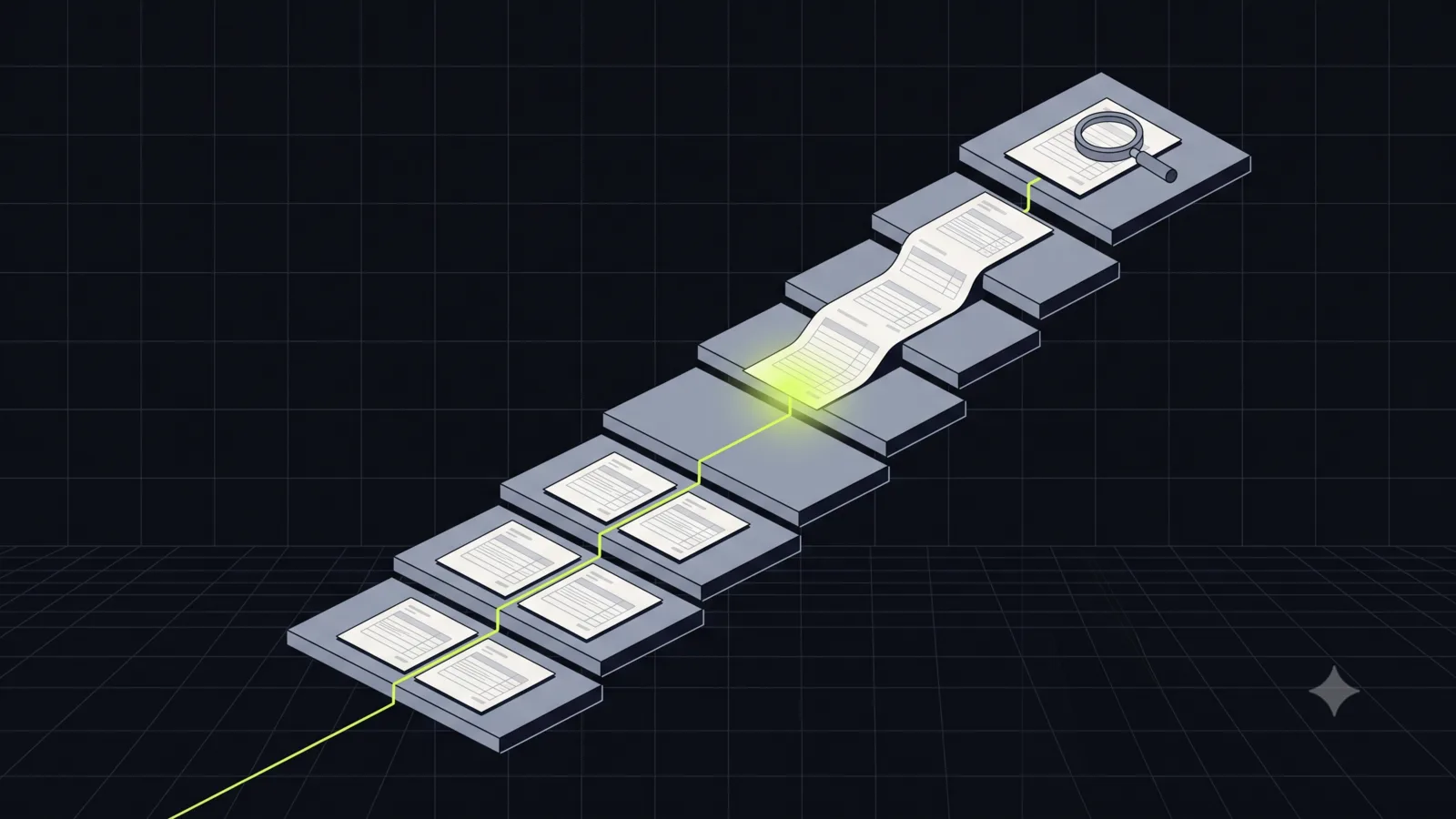
For a salaried borrower, income is a solved shape. One credit, one counterparty, a stable date, a stable amount. The analytical task is verification — confirm the credit is what it claims to be, separate reimbursements from earnings, normalise bonus and variable pay.
For a self-employed or micro borrower, none of that structure exists. Income arrives as many credits from many counterparties at irregular intervals in irregular amounts, mixed indistinguishably with loan disbursals, self-transfers, refunds and family support. There is no salary line to anchor to.
The task is not verification. It is derivation — establishing net business inflow by removing everything that is not a business receipt. A model built to locate "the salary credit" and treat everything else as other income finds nothing useful in this account, because the answer is not in any single transaction. It is in what remains after subtraction.
This is why the deck of ratios differs too. FOIR against a stable salary denominator is a meaningful number. FOIR against a denominator you derived yourself is only as good as the derivation, and for business borrowers surplus ratio and expense-to-income generally describe capacity better than a fixed-obligation ratio does — particularly when working capital interest recurs monthly without ever appearing as an EMI.
The entity boundary does not exist for a sole proprietor
In a salaried account, personal and financial life are the same thing. In a corporate account, business and promoter are separate entities with separate accounts.
The sole proprietor sits in between, and this is where retail logic produces its most consistent errors. This is also not a niche. Of roughly 9.6 crore enterprises on the Udyam register and the Udyam Assist Platform combined, about 9.55 crore are classified micro, more than 99% of the base. The typical Indian business borrower is not a company with a finance function. It is one person and one account. The same account pays school fees and buys inventory. It receives customer payments and funds a family wedding.
A retail model reads the inventory purchase as unexplained large spend. A corporate model reads the school fees as an anomaly. Neither is wrong within its own frame, and neither is right for this borrower — because the correct treatment is to recognise both as expected, classify the school fees as drawings and the inventory as business expenditure, and hold them apart in the analysis while acknowledging they share an account.
Get this wrong and two things follow. Business expenses inflate personal spend, depressing apparent surplus. Personal drawings disappear into business costs, which understates how much the promoter actually extracts from the business — the number that determines whether the business can service anything.
Two cheque returns that mean opposite things
This is the error with the largest consequence, and it survives in most systems because both events land in a single field called "bounce".
One event is the borrower's own payment failing. Their cheque, their mandate, their money that was not there. This is conduct, and it belongs in the borrower's repayment assessment.
The other is a cheque the borrower deposited coming back unpaid. Someone who owed the borrower money failed to pay. The borrower did nothing wrong.
The labels invert depending on whose books you are reading, which is exactly why this goes wrong so often. Indian banks name the direction from their own side of the clearing. A cheque drawn on the bank's own customer arrives through inward clearing, so the borrower's own dishonour is recorded as an inward return. A cheque the borrower deposited is sent out for collection, so their customer's default comes back as an outward return. Read from the borrower's side the intuition runs the other way, and plenty of downstream systems label it that way instead. Establish which convention your feed uses before wiring any rule to the field, because the two are not distinguishable after the fact.
For a salaried applicant the distinction rarely arises. For a business it is central. Treating a returned deposit as borrower conduct inverts the meaning: you penalise a borrower for their customer's default. A business with a run of returned deposits has a receivables problem, and their debtors are failing. That is genuinely important credit information, but it describes the quality of their book, not their willingness to pay you.
Read correctly, a rising count of returned deposits is one of the earliest available indicators that a business's customers are in trouble, and it typically precedes the borrower's own difficulties by months. Read as conduct, it declines a borrower who is currently paying perfectly.
The borrower's own failures then need a further split into technical and non-technical, as set out in our NACH return code reference. Three distinct signals, three distinct meanings, one field in most systems.
Normal is segment-specific, so fraud rules must be too
Every behavioural fraud indicator is conditional on what the borrower's account ought to look like. Applied across segments, the same rule is diagnostic in one and pure noise in another.
| Pattern | Salaried | Self-employed / micro | SME / corporate |
|---|---|---|---|
| Round-figure credit above threshold | Unusual — investigate | Strong circular-funding indicator | Routine inter-company settlement |
| Negative end-of-day balance | Material conduct signal | Notable | Routine on an OD facility |
| Same counterparty on debit and credit | Unusual | Primary circularity indicator | Expected in a group with real inter-company trade |
| NEFT or RTGS exceeding 2× average monthly balance | Anomalous | Worth checking | Normal in a high-velocity, low-balance account |
| Large debit immediately after a credit | Classic salary-routing signal | Less meaningful | Normal supplier payment cycle |
| Nil credits between the 20th and the 5th | Not applicable | Worth checking | Strong window-dressing indicator |
A single ruleset applied to all three columns generates false positives at a rate that teaches credit teams to ignore the flags entirely — which is worse than having no flags, because the institution now believes it has a control it does not have.
Counterparties: peripheral for retail, central for business
For a salaried borrower the counterparty set is small and stable: an employer, some financial institutions, a handful of personal contacts. It is useful mainly for confirming the employer and identifying obligations.
For a business, counterparties are the analysis. Which buyers contribute what share of receipts. Whether concentration is rising. Whether a top buyer has disappeared. Which suppliers are being paid and on what cycle. Whether the same party appears on both sides.
This requires the counterparty to be explicitly identified and named on every transaction, not inferred from a category. A tool that classifies a transaction as "transfer" without resolving who the other party was has recorded the movement and lost the analysis — concentration cannot be computed, circularity cannot be detected, and a lost customer is invisible.
That resolution is exactly what varies most between tools. In our 200,001-transaction benchmark, a substantial portion of the disagreement set consisted of transactions labelled with the narration string echoed back rather than with an identified counterparty — technically not false, analytically empty, and disproportionately damaging in the business segments.
Multi-account is the default, not the exception
Salaried borrowers frequently have one relevant account. SME and corporate borrowers almost never do: a current account for operations, an OD or CC facility, sometimes a separate collection account, often accounts at more than one bank.
This makes consolidation and self-transfer netting mandatory rather than optional for business analysis. Analysed separately and added, four accounts double-count every rupee of internal movement and inflate apparent turnover by the volume of money the borrower simply shifted around. The full sequence for handling this matters more the more accounts are involved, which is to say it matters most exactly where retail-derived tools are weakest.
Facility-level detail follows from the same point. OD and CC limits, overdrawn days, utilisation cycles and interest servicing are meaningless concepts for a salaried account and central for a business one, where they describe the working capital cycle directly.
The regulator already reads these accounts this way. Under the asset classification directions RBI consolidated in November 2025, a cash credit or overdraft account is out of order if the outstanding stays continuously above the sanctioned limit or drawing power, whichever is lower, for 90 days, or if there are no credits for 90 continuous days, or if the credits over the previous 90 days do not cover the interest debited in that period. Those are three behavioural tests on a business account, and none of them has any analogue in a salaried file.
Micro and MFI borrowers are a third case, not a smaller second one
The self-employed micro segment is frequently folded into either retail or SME. It resembles neither.
It is also a defined regulatory category rather than a loose description. Under RBI's microfinance framework a microfinance loan is a collateral-free loan to a household with annual household income up to ₹3,00,000, where household means husband, wife and their unmarried children, and each lender must run a board approved policy capping the household's monthly repayment outflow at no more than 50% of monthly household income, computed across every outstanding loan the household carries, collateralised or not. That is a rule about total household obligation, and it can only be tested against a source that sees all of it.
Income is cash-heavy and partially invisible. Obligations run across multiple small-ticket lenders, from MFIs and NBFCs to informal sources, and bureau coverage is genuinely uneven. The Micro Finance Industry Network said on 1 September 2026, releasing its quarterly Micrometer, that loans are being shifted from the microfinance bureau into retail bureaus and that it has taken the issue up with RBI. That migration fragments the very household view the 50% cap depends on. Transaction volumes are low enough that a single month's variation is not a trend. And the personal-business boundary is not merely blurred, it is absent.
A model tuned for SME multi-account consolidation is as wrong here as a retail model is, in the opposite direction.
What this means when selecting a tool
Three questions worth asking any vendor, each of which is difficult to answer convincingly without genuine segment-specific logic:
- Does the categorisation taxonomy differ by borrower type, or is it one list with more entries? Business-specific classes — bill discounting, inter-company settlement, drawings, facility interest — either exist or they do not.
- Are fraud rules tuned per segment? Ask what the round-figure-credit rule does differently for a sole proprietor and a corporate. If the answer is nothing, the false positive rate is being paid by your analysts.
- Are the two kinds of cheque return separated? The borrower's own dishonour and a deposit that came back unpaid are different events carrying opposite meanings. It is a small question that reliably distinguishes tools built for business lending from tools adapted to it.
The underlying point is that segment fit is not a feature. It determines whether the output is describing the borrower in front of you or a borrower the model was designed for.
Frequently asked questions
Why can't the same bank statement analysis be used for salaried and business borrowers? Income arrives in a fundamentally different shape — a single verifiable credit versus a figure that must be derived by subtraction — the personal and business boundary differs, and behaviour that is normal in one segment is anomalous in the other. Applying one model produces systematic errors rather than a small loss of precision.
What is the difference between inward and outward cheque returns? Indian banks name the direction from their own side of the clearing. A cheque drawn on the bank's own customer arrives in inward clearing, so the borrower's own dishonour is an inward return. A cheque the borrower deposited is sent out for collection, so a return there is an outward return and means the borrower's customer failed to pay. Downstream systems sometimes label them from the borrower's point of view instead, which reverses both, so the convention has to be established before the field is used. What matters for credit is that one is the borrower's conduct and the other is their debtor's default, and treating the second as the first penalises a borrower for someone else's failure.
What counts as a micro, small or medium enterprise in India now? Under the thresholds notified in March 2025 and effective from 1 April 2025, micro means investment up to ₹2.5 crore and turnover up to ₹10 crore, small means ₹25 crore and ₹100 crore, and medium means ₹125 crore and ₹500 crore. Across the Udyam register and the Udyam Assist Platform, more than 99% of registered enterprises fall in the micro band.
What is the household income limit for a microfinance loan? ₹3,00,000 of annual household income, with household defined as husband, wife and their unmarried children. Lenders must also cap the household's monthly repayment outflow at a maximum of 50% of monthly household income, measured across all its outstanding loans rather than only the microfinance ones.
How should income be assessed for a self-employed borrower? By deriving net business inflow after removing self-transfers, loan disbursals, related-party credits, refunds and circular flows, rather than by locating a recurring salary-equivalent credit. Surplus ratio and expense-to-income often describe capacity better than a fixed-obligation ratio.
Why do fraud rules need to differ by borrower segment? Because the same pattern carries opposite information across segments — a round-figure credit is routine in a corporate account and a circular-funding indicator in a micro-enterprise account. A single ruleset generates false positives at rates that cause credit teams to stop acting on alerts.
Is bureau data sufficient for micro-enterprise obligations? Frequently not. Small-ticket and informal lenders report inconsistently or not at all, which makes the bank account the primary source for identifying what the borrower is actually servicing.
Fiscus applies distinct categorisation logic, ratio sets and fraud rules to salaried, self-employed and SME borrowers, with the borrower's own dishonours and their returned deposits classified separately across all accounts in a case. Book a parallel evaluation on borrowers across each of your segments.
Written by
Zeus DhanbhooraZeus Dhanbhoora is the CEO of BridgeUp Tech, the company behind Fiscus. He previously co-founded Bacferim Technologies and was an associate at the law firm Bharucha & Partners. He writes the Fiscus credit desk blog on benchmarks, fraud detection and credit underwriting methods.