[ Credit Analysis ]
Sizing a Working Capital Limit From the Account Instead of the Projection
Working capital assessment for cash credit and overdraft limits. The turnover, MPBF and cash budget methods all start from figures the borrower supplies. The account shows the observed peak funding need, how long the trough lasts, and whether an existing facility still revolves.
11 min read · 6 October 2026
Contents
- The methods side by side
- The observed peak is not the calculated requirement
- The swing test
- Utilisation metrics that actually mean something
- The regulatory tests the account already has to pass
- Seasonality is a structuring input, not a risk flag
- Renewal is a different question from sanction
- What the account cannot tell you
- Frequently asked questions
Working capital assessment is how a lender sizes a cash credit or overdraft limit. In India it is done by the turnover method, a working capital gap (MPBF) method or a cash budget, and all three start from figures the borrower supplies. The bank account adds what none of them can: how deep the funding need actually ran, for how long, and whether an existing limit is still revolving at all.
Three methods dominate working capital limit setting in India, and they share a weakness.
The turnover method, from the Nayak Committee, takes the working capital requirement as 25% of projected annual turnover. The borrower brings 5% as margin and the bank finances a minimum of 20%. RBI applies it to micro and small enterprises with limits up to ₹5 crore. Banks test the projection against past accounts and tax returns, but it remains a percentage of a figure that has not happened yet.
The working capital gap method, from the Tandon Committee, computes current assets less current liabilities other than bank borrowing, then deducts a margin. More rigorous, and dependent on a balance sheet the borrower prepared, often for a year that ended some time ago. RBI withdrew the mandatory MPBF in 1997, and banks now apply it with their own modifications.
The cash budget method projects monthly cash inflows and outflows and finances the peak deficit. RBI's guidance mentions it for large borrowers. It is the closest of the three to the account's view, and it is still a projection.
All three answer the question "how much should this business need?" The account answers a different and more useful one: how much has it actually needed, when, and for how long.
The methods side by side
| Method | How the limit is derived | What it depends on |
|---|---|---|
| Turnover (Nayak) | Requirement = 25% of projected annual turnover; bank finance at least 20%, borrower margin 5% | The borrower's turnover projection |
| MPBF, first method (Tandon) | 75% of the working capital gap (current assets less other current liabilities) | Balance sheet and projections |
| MPBF, second method (Tandon) | 75% of current assets, less other current liabilities; implies a current ratio of 1.33 | Balance sheet and projections |
| Cash budget | The peak projected monthly cash deficit | Monthly cash flow projections |
| Observed peak, from banking data | The deepest cumulative operating cash deficit actually reached, and how long it lasted | Twelve months of statements across all accounts |
The last row is not a replacement for the others. It is the cross-check none of them has.
A worked example shows why it matters. Two manufacturers each project turnover of ₹10 crore. The turnover method gives each a requirement of ₹2.5 crore and bank finance of at least ₹2 crore. If both show current assets of ₹4 crore and other current liabilities of ₹1.2 crore, the gap is ₹2.8 crore, the first Tandon method gives ₹2.1 crore and the second gives ₹1.8 crore.
Now read their accounts. The first business's cumulative deficit peaks at ₹1.2 crore and recovers within 45 days. The second's peaks at ₹3.4 crore and stays below zero for 150 days. Every calculated figure above gives them roughly the same limit. One will carry a facility well beyond anything it has drawn. The other will run past its limit through the worst of a five-month trough, and will look like a conduct problem when it is a sizing problem.
The observed peak is not the calculated requirement
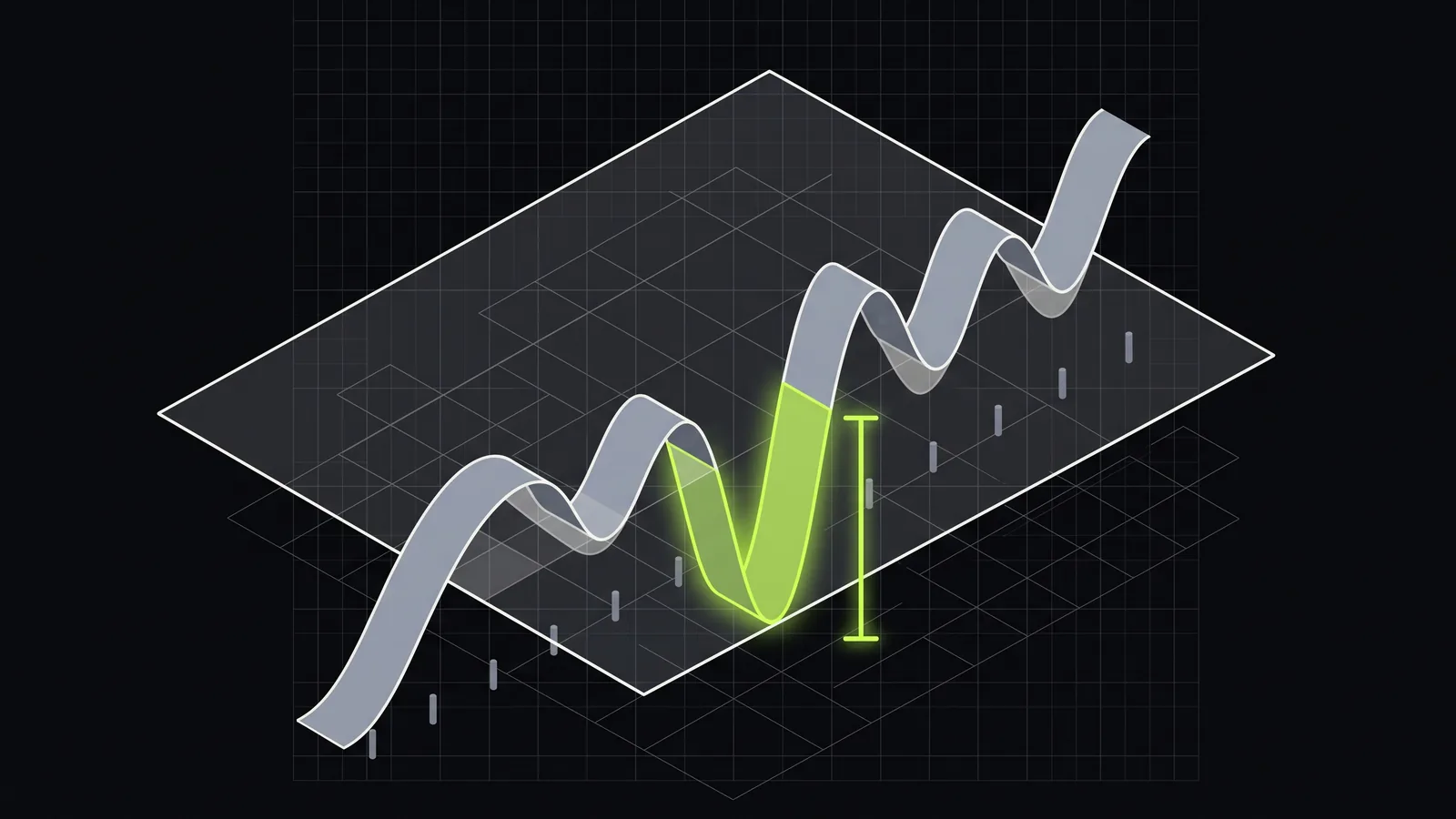
A working capital cycle has a shape. Money goes out to suppliers and wages, inventory converts, customers pay, the deficit closes. Across a year the business runs a cumulative cash position that rises and falls.
The limit should cover the deepest point of that curve, not an annual average and not a percentage of a figure that has not happened yet.
Banking shows the curve directly. Build a monthly series of net operating cash position (business receipts less operating outflows, with self-transfers, loan disbursals and related-party flows removed first), and the maximum cumulative deficit is the observed peak funding need. For a business with twelve months of statements, this is a measurement rather than an estimate.
Two businesses with identical annual turnover can have peaks that differ by a factor of three, because the peak is a function of the cash conversion cycle, not of revenue. A turnover-method calculation gives them the same limit.
Duration matters as much as depth. A business ₹40 lakh short for 20 days needs a different instrument from one ₹40 lakh short for 120 days. The first is a cash credit facility doing its job. The second is closer to a funding gap that a revolving limit will mask rather than solve.
The swing test
This is the single most diagnostic pattern in a cash credit or overdraft account, and it takes thirty seconds to read.
A healthy working capital facility swings. The borrower draws to buy inventory, the inventory converts, receipts arrive, the facility is repaid down, and the cycle repeats. The drawn balance oscillates, sometimes near the limit and sometimes well below it, repeatedly, across the year.
A facility that does not swing has stopped being working capital. If the drawn balance sits at 90 to 100% of the sanctioned limit continuously, never meaningfully coming down, the money is not financing a cycle. It is financing a hole: working capital that was consumed and never regenerated, a loss absorbed, an asset purchase made from the facility, or funds diverted elsewhere.
That account has become a term loan with no amortisation schedule, and it is one of the most common forms of concealed stress in SME lending. The borrower has not defaulted. Interest is being serviced. Because the balance stays within the limit and drawing power, the account never trips the regulatory tests that look for excess drawings, and nothing reaches the bureau. The only visible symptom is a flat line where there should be a wave.
Two numbers capture it:
- Lowest drawn balance in the period, as a share of the limit. In a revolving facility this falls substantially below the ceiling at least once per cycle. If the minimum drawn balance across twelve months is 85% of the limit, the facility has 15% of revolving capacity and 85% of permanent debt.
- Credit turnover in the account relative to the limit. A facility being revolved sees total credits several times the limit over a year. Low churn against a high drawn balance is the same finding from the other direction.
Read them together. High utilisation on its own is normal for small accounts, many of which run close to their limits most of the year. High utilisation with low churn is the finding.
When the irregular portion is eventually recognised, banks have long carved it out of the cash credit into a separate working capital term loan with its own repayment schedule. The account shows the need for that conversion a year or more before anyone proposes it.
Utilisation metrics that actually mean something
Beyond the swing, four readings worth taking from the account. Measure each against the lower of the sanctioned limit and the drawing power, because that is the line RBI's tests use.
Days above 90% of limit. Peak utilisation is a weak measure because every business touches its ceiling occasionally. The count of days spent there is the real indicator of whether the limit is sized correctly.
Overdrawn days. The facility was exceeded. Either the limit is undersized for the actual cycle or the account is being managed loosely, and the two are distinguishable by whether the excess is seasonal or scattered. A run of more than 30 continuous days over the line makes the account SMA-1.
Interest servicing source. Interest is charged at monthly rests. If it is being paid from operating inflows, the business is covering its cost of credit. If the drawn balance rises by roughly the interest amount each month, the interest is being capitalised into the limit, and the facility is growing without any new borrowing decision being made. RBI's out-of-order test catches the extreme version, where credits over 90 days do not cover the interest debited. The account shows the drift long before that, because a balance can creep up by the interest amount every month while credits still technically cover it.
Zero-balance or near-zero days in the current account alongside a fully drawn facility. The business has no liquidity buffer at all; the limit is its only source of cash. End-of-day balance analysis across both accounts shows it.
The regulatory tests the account already has to pass
Every one of these is computable from the statement, and most lenders only see them when the account has already tripped them.
| Test | The rule | What to compute from the account |
|---|---|---|
| SMA-1 and SMA-2 | Outstanding continuously above the lower of the sanctioned limit and drawing power for more than 30 days (SMA-1) or more than 60 days (SMA-2) | Daily balance against limit and drawing power; the longest continuous run above it |
| Out of order: excess | Outstanding continuously above the limit or drawing power for 90 days, which makes the account an NPA | The same run, at 90 days |
| Out of order: no credits | Outstanding below the limit but no credits continuously for 90 days | The longest gap between credits |
| Out of order: interest | Outstanding below the limit but credits in the previous 90 days not enough to cover the interest debited | Rolling 90-day credits against rolling 90-day interest debits |
| Stale drawing power | Drawing power from a stock statement older than three months makes the outstanding irregular | Not visible in the account; needs the stock statement date |
| Renewal | Limits reviewed within three months of the due date; an account not reviewed or renewed within 180 days is an NPA | Not an account test, but the year of conduct is the evidence the review should rest on |
Sources: RBI's income recognition and asset classification directions and stressed assets directions for commercial banks, as updated on 1 October 2026.
Seasonality is a structuring input, not a risk flag
Twelve months of banking establishes the trading calendar: which months generate cash, which consume it, and how deep the trough runs.
A business with a four-month build-up before a two-month selling season is not a riskier borrower than a steady one. It is a borrower whose facility should be sized to the peak and whose repayment expectations should follow the cycle. Sized to the average, it will be overdrawn for a third of the year and will look like a conduct problem.
This also means six months of statements is inadequate for working capital assessment in a way it is not for a term loan. A six-month window that happens to sit inside the trough overstates the need; one inside the peak season understates it. The cycle has to be observed in full, which is why bank MSME checklists commonly ask for twelve months of statements for every account the business operates.
Renewal is a different question from sanction
At renewal you have something you did not have at sanction: a year of evidence about how the limit was actually used.
Four questions the account answers directly.
Was the limit used? A facility drawn to 30% of its ceiling all year ties up the lender's capital for no purpose, and where the bank levies commitment charges on unused limits, it costs the borrower too. Many banks do on larger limits: Canara Bank's current schedule, for instance, charges on limits above ₹10 crore when average utilisation falls below 75%. That is a renewal to be resized downward, which is a conversation most relationship managers avoid and most borrowers accept once the economics are shown. Whatever the decision, the finding belongs in the renewal note as a testable condition, in the way set out in our post on what a credit appraisal memorandum should contain.
Did it swing? As above. A limit that stopped revolving during the year is the single most important finding available at renewal, and it will not appear in financials, where the closing balance simply looks like normal bank borrowing.
Did the business grow into it or out of it? Compare operating throughput against the prior period. Rising throughput with stable utilisation argues for an increase; falling throughput with rising utilisation argues for the opposite, and is the combination that most reliably precedes difficulty. It appears in our list of early warning signal pairs for exactly this reason.
Where did the money go? If the facility was drawn and the funds moved immediately to a group entity or the promoter, the working capital limit financed something other than working capital. Netting related-party and self-transfer flows is what makes that visible; without it, the outflow looks like an ordinary supplier payment. RBI's credit risk management directions now require banks to monitor a borrower's accounts and cash flows at the borrower level as well as the account level, and to flag frequent pass-through activity. A renewal that reads only the cash credit account does not meet that standard.
What the account cannot tell you
Limit sizing is not purely a cash question, and the account has clear boundaries.
It does not show stock. Drawing power is assessed against inventory and book debts, and requires stock statements and verification that the account cannot substitute for. It shows that money was spent, not what was bought or whether it still exists.
A short example of why that matters. A borrower reports stock of ₹80 lakh against trade creditors of ₹20 lakh, leaving ₹60 lakh; at a 25% margin that supports ₹45 lakh. Book debts are ₹50 lakh, of which ₹10 lakh are older than 90 days and excluded; at a 40% margin the remaining ₹40 lakh supports ₹24 lakh. Drawing power is ₹69 lakh against a sanctioned limit of ₹75 lakh. A drawn balance of ₹72 lakh held for 35 days is within the limit, and the account is still SMA-1, because the test runs against the lower of the two. Margins and the ageing cut-off are set by each bank's policy; the logic is the same everywhere.
It does not show the quality of receivables behind the credits. A business collecting promptly from a customer who is itself in difficulty looks identical to one collecting from a solid counterparty, which is why counterparty concentration belongs in the same assessment.
It does not show security, contingent liabilities, or borrowings held at institutions whose accounts you were not given.
What it does show, better than any projection, is the shape and depth of the actual cash requirement and whether the facility already extended is still doing the job it was sanctioned for.
Frequently asked questions
How is a working capital limit calculated? By the turnover method, where the requirement is 25% of projected annual turnover and the bank finances at least 20% (used for micro and small enterprises with limits up to ₹5 crore); by a working capital gap or MPBF method, computing current assets less non-bank current liabilities and deducting a margin; or by a cash budget that finances the peak projected deficit. All three depend on borrower-supplied projections or balance sheets, which is why the observed peak funding need from banking data is a useful cross-check.
What is drawing power in a cash credit account? The amount a borrower can actually draw at a given time, calculated from current stock and eligible book debts less the bank's margins. It is often lower than the sanctioned limit, and RBI's tests run against whichever of the two is lower. Drawing power based on a stock statement older than three months makes the outstanding irregular.
What does it mean when a cash credit account is always fully drawn? The facility has stopped revolving and has effectively become a term loan without an amortisation schedule. It usually indicates working capital that was consumed and not regenerated, through a loss, an asset purchase funded from the limit, or diversion. Interest may be serviced normally throughout, and as long as the balance stays within the limit and drawing power, nothing appears in bureau data.
When does a cash credit account become an NPA? When it is out of order: the outstanding stays above the sanctioned limit or drawing power continuously for 90 days, or there are no credits for 90 days, or credits in the previous 90 days do not cover the interest debited. An account whose limits are not reviewed or renewed within 180 days of the due date is also an NPA.
How much bank statement history is needed for working capital assessment? Twelve months. A shorter window cannot capture the full cash conversion cycle, and six months sitting inside either the peak or the trough produces a materially wrong figure in either direction.
What is the difference between peak utilisation and days above 90%? Nearly every business touches its ceiling occasionally, so peak utilisation says little. The number of days spent above 90% indicates whether the limit is genuinely sized to the cycle or is being used as a permanent source of funds.
Can banking data replace stock statements for drawing power? No. Drawing power is assessed against inventory and book debts, which the account cannot verify. Banking shows that money moved and where it went, not what was purchased or whether it remains.
Fiscus reports utilisation and overdrawn days for every facility account, alongside netted operating cash flow month on month across all of a borrower's accounts. Book a parallel evaluation on working capital cases your team has already assessed.
Written by
Zeus DhanbhooraZeus Dhanbhoora is the CEO of BridgeUp Tech, the company behind Fiscus. He previously co-founded Bacferim Technologies and was an associate at the law firm Bharucha & Partners. He writes the Fiscus credit desk blog on benchmarks, fraud detection and credit underwriting methods.